
Anúncios
The future of work in 2030 will be shaped by rapid technological advancements, demographic changes, and shifting economic landscapes. While some jobs will disappear due to automation, new roles will emerge that emphasize creativity, emotional intelligence, and complex problem-solving. By 2030, the workforce will experience a net gain in jobs, with many requiring constant digital upskilling and adaptability.
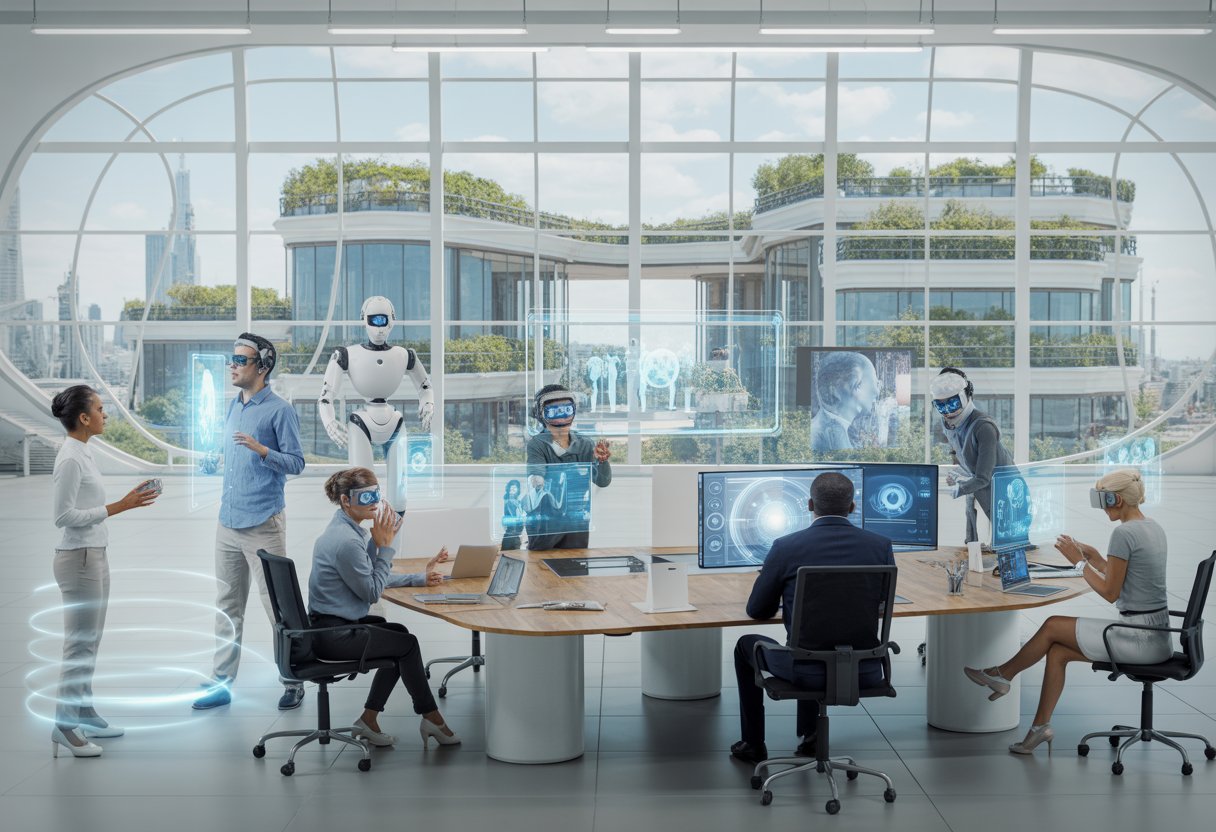
Work models will evolve, integrating AI more deeply into everyday tasks and expanding remote and hybrid options. The demand for human-specific skills will grow as machines handle more routine technical jobs. Industries will continuously transform, influenced by global economic pressures and sustainability goals.
Individuals and organizations that prepare for these changes by embracing lifelong learning and flexibility will be better positioned to thrive. The future workplace will not only require new technical skills but also a renewed focus on human capabilities that technology cannot replicate.
Emerging Trends Shaping the Future of Work

Significant shifts in technology and workplace culture are creating new dynamics in employment. These shifts are transforming tasks, work locations, and industry operations, influencing the skills and roles required by 2030.
Rise of Automation and Artificial Intelligence
Automation and AI are increasingly handling repetitive and data-driven tasks. This shift allows workers to focus on complex problem-solving, creativity, and interpersonal skills.
By 2030, many routine roles will be partially or fully automated. However, new jobs involving AI management, programming, and oversight will grow. Workers will need advanced digital literacy and the ability to collaborate with intelligent systems.
Automation also drives efficiency in sectors like manufacturing, logistics, and customer service. Companies investing in AI aim to improve output and reduce human error while redeploying employees toward strategic initiatives.
Expansion of Remote and Hybrid Work Models
Remote and hybrid work arrangements have become foundational in many companies. These models offer flexibility, reduce commute time, and widen talent pools globally.
By 2030, hybrid teams will be standard in various industries, combining in-person collaboration with digital communication tools. This requires strong virtual management skills and new workplace policies supporting remote productivity and engagement.
While remote work broadens opportunities, it also increases the importance of cybersecurity and digital infrastructure. Employers will balance remote benefits with maintaining company culture and team cohesion.
Digital Transformation Across Industries
Digital tools are reshaping how businesses operate, from supply chains to customer interactions. Technologies like cloud computing, IoT, and data analytics are integral to this transformation.
Industries that historically relied on manual processes are adopting digital platforms for efficiency and scalability. Employees must adapt through continuous learning and data-driven decision-making.
Digital maturity will influence competitive advantage, making tech fluency a core requirement for future roles. Organizations increasingly rely on cross-functional teams skilled in both domain knowledge and digital competencies.
The Evolution of In-Demand Skills

The job market in 2030 will prioritize a blend of technical capabilities and human-centered skills. Workers will need to adapt continuously, combining digital know-how with strong analytical abilities and emotional intelligence. This mix will be key for navigating complex, technology-driven environments while maintaining effective interpersonal relationships.
Technological Proficiency and Digital Literacy
Technological skills will no longer be optional but fundamental across nearly all industries. Proficiency with digital tools, data analysis, and emerging technologies like AI and automation will be essential. Workers should be comfortable navigating advanced software, cloud platforms, and cybersecurity basics.
Continuous learning to keep pace with rapid tech evolution will be important. Specialized skills such as programming, machine learning, or blockchain knowledge will offer advantages but a broad digital literacy remains critical. The ability to interpret and leverage data for decision-making will often differentiate successful candidates.
Emphasis on Critical Thinking and Problem Solving
Critical thinking will continue to be one of the most sought-after skills. Employers value employees who can analyze complex information, identify patterns, and develop innovative solutions. This skill set supports adaptability and flexibility in constantly changing workplaces.
Problem solving will involve both technical and creative approaches. Workers must evaluate risks, consider ethical implications, and anticipate future challenges. This includes questioning assumptions and applying logical frameworks to work through ambiguity and uncertainty.
Importance of Emotional Intelligence
Emotional intelligence will grow in significance as collaboration and leadership demand more nuanced interpersonal skills. Understanding and managing one’s own emotions, as well as empathizing with others, helps build trust and effective teams.
Emotional intelligence enables clear communication and conflict resolution, which remain crucial despite digital communication advances. Leaders will rely on these skills to inspire, motivate, and manage diverse workforces. It is a key differentiator in roles requiring social influence and negotiation.
Jobs of 2030: Key Sectors and Roles
Emerging technologies and societal shifts will drive significant job growth in specialized fields. These changes will shape distinct roles requiring updated skills and expertise to meet evolving demands.
Healthcare and Biotechnology Innovations
Advancements in healthcare and biotechnology will create jobs focused on personalized medicine and advanced diagnostics. Roles like genetic counselors, biomedical engineers, and telehealth specialists will become standard.
AI-driven tools will assist professionals in predicting diseases and managing chronic conditions. Biotechnology breakthroughs will require experts to develop gene-editing therapies and regenerative treatments.
Healthcare workers will need both technical and interpersonal skills as patient care integrates with digital platforms and wearable health devices. The demand for remote health monitoring and data analysis is expected to rise sharply.
Green Energy and Sustainability Careers
The shift toward renewable energy will expand roles in solar, wind, and battery technology industries. Specialists in environmental engineering and energy management will be crucial for developing sustainable infrastructure.
Jobs like climate risk analysts and sustainability consultants will grow to address corporate and government climate goals. Skills in environmental regulations, carbon footprint accounting, and green design are increasingly important.
Technicians and engineers will be tasked with maintaining and improving renewable energy systems. These careers support the transition away from fossil fuels and contribute to global emission reduction.
Growth in Data Science and Analytics
Data science will underpin most industries by 2030, demanding skilled analysts, machine learning engineers, and AI specialists. These roles focus on extracting actionable insights from vast datasets.
Big Data specialists will work with predictive models to improve decision-making in finance, healthcare, marketing, and beyond. Proficiency in programming, statistical analysis, and data visualization remains essential.
Organizations will rely on data professionals to enhance automation, optimize processes, and identify trends. Ethical data management and cybersecurity skills will also be critical as data use expands.
The Changing Nature of Job Structures
Work arrangements are evolving to emphasize flexibility, adaptability, and collaboration. Traditional full-time roles are giving way to varied models that better align with technological advances and shifting workforce expectations.
Project-Based and Gig Economy Work
Jobs increasingly revolve around specific projects rather than fixed positions. Organizations hire talent for defined tasks, often on short-term contracts or freelance arrangements.
This model allows companies to scale their workforce quickly and access specialized skills as needed. For workers, it offers flexibility but requires continuous skill updating and self-management.
Platforms that connect freelancers with clients are central to this shift, creating global opportunities for independent professionals. However, challenges like income instability and limited benefits remain important considerations.
Fluid Career Paths and Lifelong Learning
Rigid career ladders are becoming obsolete. Employees follow non-linear paths, moving between roles, industries, and skill sets throughout their careers.
Lifelong learning is essential as workers must adapt to new technologies and evolving job demands. Continuous training, certifications, and reskilling programs are integral to maintaining relevance in the labor market.
Employers increasingly support ongoing education and skill development to enhance workforce agility. This trend promotes adaptability but also requires individuals to be proactive about their growth.
Multi-Disciplinary Teams in the Workplace
Organizations prioritize collaboration across diverse skill sets and expertise areas. Teams often combine technical, creative, and analytical talents to solve complex problems.
This approach encourages innovation by integrating different perspectives and fostering knowledge sharing. It requires strong communication and coordination skills.
Employees must be comfortable working across disciplines and adapting to changing team compositions. Such dynamic workgroups help businesses respond effectively to rapid market and technological changes.
Preparing for the Future Workforce
Adapting to the evolving job market requires targeted strategies focused on skill development, ongoing learning, and modernized education systems. Preparing workers to meet new demands involves addressing skill gaps and fostering adaptability.
Reskilling and Upskilling Initiatives
Reskilling and upskilling are essential to address the displacement of jobs caused by automation and AI. Employers and governments increasingly invest in programs that teach new skills related to emerging technologies and evolving job roles.
These initiatives focus on practical skills like digital literacy, data analysis, and technical competencies alongside soft skills such as problem-solving and adaptability. Customized training paths help workers transition into new positions, preserving employability.
The World Economic Forum projects that over a billion workers will need reskilling by 2030. Coordinated efforts between companies and educational institutions improve the effectiveness of these initiatives, speeding workforce adaptation.
Embracing Continuous Professional Development
Continuous professional development (CPD) ensures workers upgrade skills throughout their careers to stay relevant. In a fast-shifting labor landscape, CPD fosters lifelong learning as a norm rather than an exception.
CPD often involves flexible, modular learning methods like online courses, micro-credentials, and workshops. These formats accommodate working professionals needing quick access to new skills without disrupting their employment.
Employers benefit by investing in CPD through increased employee performance and retention. The emphasis on ongoing development supports resilience amid technological changes and industry transformations.
Role of Education and Training Programs
Education systems must align curricula with future skill demands, integrating STEM, AI literacy, and critical thinking from early stages. Vocational training and apprenticeships provide practical experience linked directly to labor market needs.
Collaboration between educational institutions and industries allows for adaptive program design. This ensures graduates possess skills applicable to real-world job requirements, reducing entry barriers and improving workforce readiness.
Adaptive learning technologies and competency-based assessments also play a role in modernizing education. They provide personalized learning experiences that cater to diverse student needs and evolving job competencies.
Challenges and Opportunities Ahead
The future workplace will be shaped by rapid technological changes, requiring adaptation in skills, ethics, and workforce composition. Balancing job transitions with social equity and ethical use of technology is imperative for sustainable growth.
Addressing Job Displacement
By 2030, an estimated 92 million jobs will be displaced due to automation and AI, but 170 million new roles are expected to emerge. This shift demands comprehensive reskilling programs focused on digital literacy, critical thinking, and adaptability.
Countries and companies must invest in lifelong learning initiatives to equip workers for emerging fields like AI development, green energy, and data science. Failure to support displaced workers may exacerbate unemployment and economic inequality.
Promoting collaboration between governments, educational institutions, and businesses will help design effective transition strategies. Proactive policies on retraining and social protections can reduce the short-term impact of displacement while leveraging the overall net job growth.
Promoting Workplace Diversity and Inclusion
Workplace diversity will be critical as organizations globalize and automate. Inclusion efforts must address not only gender, ethnicity, and age but also neurodiversity and accessibility.
Companies benefit from broader perspectives that streamline innovation and decision-making. This requires inclusive hiring practices, bias reduction training, and flexible work environments.
Technology itself can support diversity through AI-driven unbiased recruitment tools and accommodations. However, it must be carefully managed to avoid perpetuating existing inequalities or introducing new biases.
Building cultures of respect and belonging will help retain talent and improve employee satisfaction, which is essential in a competitive job market shaped by globalization and remote work dynamics.
Navigating Ethical Considerations
The integration of AI and automation raises significant ethical questions about privacy, decision-making, and accountability. Organizations need clear guidelines on transparency and data protection.
Ethical concerns also involve job fairness, such as ensuring algorithms do not discriminate or replace human judgment in critical areas without oversight.
Regulations and corporate responsibility efforts must align to prevent misuse of technology and protect workers’ rights. Ethical AI development requires multidisciplinary collaboration involving technologists, ethicists, and policymakers.
Workforces must be prepared to engage with ethical dilemmas actively. This includes training in responsible AI use and fostering a culture where ethics guides innovation and operational decisions.
How Organizations Can Adapt
Organizations must focus on practical strategies that enhance workforce productivity and flexibility while addressing evolving employee needs. Prioritizing resources towards supportive environments and adaptable team structures will be critical.
Investing in Employee Well-Being
Organizations should implement comprehensive well-being programs that address physical, mental, and emotional health. This includes access to counseling services, flexible work schedules, and initiatives promoting work-life balance.
Employee well-being directly impacts productivity and retention. Encouraging regular breaks, mindfulness practices, and health screenings can reduce burnout and absenteeism.
Data-driven approaches help identify specific employee needs. Surveys and feedback tools allow organizations to tailor resources effectively and monitor the impact of well-being initiatives over time.
Building Agile and Resilient Teams
Agility requires organizations to develop teams that can quickly adjust to market changes and new technologies. Cross-functional skills and continuous learning are essential for this adaptability.
Resilient teams incorporate diverse perspectives and strong communication channels. This combination supports problem-solving under uncertainty and fosters innovation.
Tools such as collaborative platforms and project management software enable real-time coordination. Regular training and scenario planning prepare teams for unexpected disruptions, maintaining operational continuity.
Global Impacts and Policy Considerations
Emerging technologies and global economic shifts demand precise policy adjustments. Governments must address changing work structures while ensuring fair access to new opportunities.
Redefining Labor Laws and Regulations
As automation and AI reshape job roles, labor laws need updating to reflect these realities. Policies must protect gig and platform workers, who often lack traditional employment benefits.
New regulations should incorporate flexible work arrangements while maintaining standards for wages, safety, and social security. Governments may consider expanding unemployment benefits and retraining support to help workers transition into emerging industries.
Legal frameworks must also address data privacy and algorithmic fairness in hiring and performance evaluations. Ensuring transparency will be key to preventing biases in automated decision-making.
Bridging the Digital Divide
Unequal access to digital tools remains a barrier to workforce participation worldwide. Without targeted investment, remote and underserved populations risk exclusion from growth sectors.
Policies should promote affordable broadband infrastructure in rural and low-income urban areas. Education systems need to emphasize digital literacy and technical skills, starting early to prepare future generations.
Public-private partnerships can expand access to training programs that align with market demands, such as AI and data science. Closing this divide supports economic inclusion and maximizes the benefits of new job creation.
Conclusion
The job market in 2030 will be shaped by significant technological, demographic, and environmental changes. While 92 million jobs are expected to disappear, 170 million new roles will emerge, resulting in a net growth of 78 million positions.
Workers will need to continuously adapt by developing new skills, especially those related to artificial intelligence, automation, and green technologies. Reskilling and lifelong learning will be essential for staying relevant in this evolving landscape.
Emerging careers will span sectors like healthcare, renewable energy, technology, and creative industries. Employers and educational systems will both have key roles in preparing the workforce for these shifts.
| Key Drivers | Impact on Jobs |
|---|---|
| Automation & AI | Job displacement, new tech roles |
| Demographic Shifts | Increased demand in healthcare & services |
| Climate Change | Growth in sustainable and green jobs |
| Geoeconomic Tensions | Diverse regional job creation and loss |
Embracing these changes requires proactive planning at individual, institutional, and policy levels to ensure the workforce can meet future demands effectively. The workforce of 2030 will be more dynamic, diverse, and technology-integrated than ever before.